

Table of Contents
- What "Affordable Clothing Like The Curated" Actually Means
- 10 Affordable Capsule Wardrobe Essentials That Look Expensive
- How to Build a Timeless Wardrobe on a Budget
- Quiet Luxury Brands for Less: What to Look For
- How Hoss Style & Co Compares to The Curated
- Getting the Fit Right the First Time
- Conclusion
- Frequently Asked Questions
Last Updated: September 11, 2026
What "Affordable Clothing Like The Curated" Actually Means
Affordable clothing like The Curated means well-cut, neutral-toned staples that cost a fraction of luxury prices without looking cheap. This guide from Hoss Style & Co LLC covers spotting quality construction, building a capsule wardrobe, and stretching every dollar.
The difference comes down to fabric weight, seam finishing, and whether a piece survives more than one season. A dress that costs less but lasts three years beats a cheaper one that pills after two washes.
10 Affordable Capsule Wardrobe Essentials That Look Expensive
The core of any affordable capsule wardrobe essentials list is versatility: each piece should work across at least three outfits. Ten well-chosen items can replace thirty impulse buys.
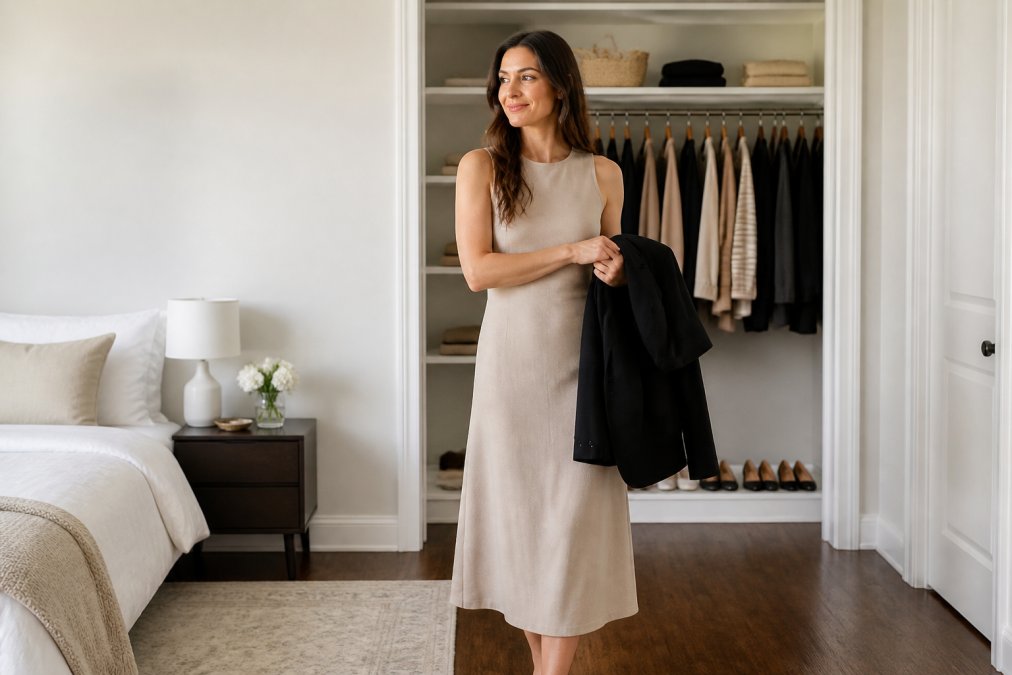
A common mistake is buying ten variations of the same silhouette. Mix structured pieces with soft ones instead.
Dresses That Work Overtime
A midi dress in a solid or subtle print handles more occasions than almost anything else in a closet. The Printed Waist-Cinched V-Neck Dress at $24.45 creates shape with a cinched waist and stays wearable spring through fall. For cooler months, the Cable Knit Midi Dress at $31.16 layers easily under a coat, and the UrbanCharm Denim Midi Dress at $41.14 handles the structured end with adjustable buckle straps.


Structured Separates and Denim
Tailored pieces are where cheap clothing gives itself away, so spend a little more here. The Women's Blazer and Wide Leg Pants Set at $127.57 delivers a coordinated office look that also works split apart. The Women's High Waist Button Front Jeans at $55.78 anchor casual outfits, while the Women's Knit Two Piece Lounge Set at $44.13 covers the relaxed end.
| Essential | Price | Best For | Cost-Per-Wear (at 30 wears) |
|---|---|---|---|
| Printed Waist-Cinched V-Neck Dress | $24.45 | Casual outings, workdays | $0.82 |
| Cable Knit Midi Dress | $31.16 | Cooler months, layering | $1.04 |
| UrbanCharm Denim Midi Dress | $41.14 | Day-to-night wear | $1.37 |
| Blazer and Wide Leg Pants Set | $127.57 | Office, events | $4.25 |
| High Waist Button Front Jeans | $55.78 | Everyday casual | $1.86 |
| Knit Two Piece Lounge Set | $44.13 | Travel, weekends | $1.47 |
How to Build a Timeless Wardrobe on a Budget
Building a timeless wardrobe on a budget starts with a wardrobe edit: pull everything out, keep what fits and flatters, and note the gaps. Most people own far more than they wear.
Work in three passes:
- Remove anything unworn in the past year
- Identify repeat outfit formulas you actually use
- Buy only pieces that fill two or more of those formulas
The Women's Sleeveless Knit Midi Dress at $61.59 is a good gap-filler: it layers under a blazer in winter and stands alone in summer. The Women's Satin Slip Maxi Dress at $48.13 covers the dressier end.
The Cost-Per-Wear Math That Changes Everything
Cost-per-wear is the purchase price divided by the number of times you wear the item. A $24.45 dress worn 30 times costs $0.82 per wear; a $60 impulse buy worn twice costs $30 per wear. That is the trap.
It is not about spending less; it is about spending where the wear count is high.
Quiet Luxury Brands for Less: What to Look For
Quiet luxury brands for less share a few traits: neutral palettes, no visible logos, and fabric that holds its shape. You can spot them by touch and construction rather than by label. But the real differentiator is what happens after you buy: a $40 dress that still looks sharp after 40 wears beats a $200 one that pills by month three.
Read the Fiber Label Like a Buyer, Not a Shopper
Start with the fiber content tag. Under the Federal Trade Commission's textile labeling rules, apparel sold in the U.S. must disclose fiber content by percentage, so you can verify what you are actually buying before checkout (the FTC). the Federal Trade Commission's guidance on textile labeling
A few composition patterns worth knowing:
- 100% wool or wool-dominant blends hold shape and resist odor, but can felt if washed hot. Look for "worsted" or "merino."
- Cashmere is graded by fiber length and diameter; longer, finer fibers pill less. A 2-ply or 4-ply sweater at a mid price often outperforms a thin 1-ply at a luxury price.
- Silk should feel cool and slightly weighted, not slippery-plastic. Charmeuse drapes; cheaper "satin" polyester mimics the shine without the breathability.
- Cotton quality tracks with staple length. Long-staple and extra-long-staple (Pima or Supima) resist pilling and hold color longer than standard upland cotton (peer-reviewed research).
- Polyester blends are not automatically bad. A cotton-poly twill with a tight weave can outlast a loose 100% cotton poplin, especially in structured pieces like blazers.
Construction Details That Separate $40 From $400
Run your fingers along the inside of the garment. The tells:
- Seam finishing: French and bound seams hide raw edges and resist fraying. Serged-only seams are fine on knits but a warning sign on woven blazers and trousers.
- Stitch density: More stitches per inch means a stronger seam. Compare the hem of a piece you love to a candidate, the difference is usually visible.
- Lining: A full lining in a blazer or skirt protects the outer fabric and helps it drape. Unlined structured pieces wrinkle and wear faster.
- Buttons and hardware: Plastic buttons on a wool coat are a cost signal. Horn, corozo, or metal hardware suggests the maker expected the piece to last.
- Color consistency: A tight neutral palette means everything mixes, which multiplies the outfits per piece.
The Longevity Angle Most Guides Skip
Affordable pieces look expensive for one reason: they are maintained. A few habits extend their life dramatically.
- Wash less, air more. Wool, cashmere, and silk rarely need full washing. Spot-clean and air between wears.
- Use mesh bags and cold water for knits. Heat and agitation cause pilling and shrinkage.
- Fold, don't hang, knits. Hangers stretch shoulders and distort the neckline.
- Invest in a fabric shaver and a lint brush. A $10 shaver revives a pilled sweater in five minutes.
- Cedar blocks and breathable garment bags protect wool from moths without seasonal dry-cleaning.
A Quick Fabric-to-Care Cheat Sheet
| Fiber | Looks Expensive When… | Care Habit That Extends Life |
|---|---|---|
| Wool / merino | Tight knit, worsted finish | Air between wears, cold hand-wash, dry flat |
| Cashmere | 2-ply or higher, long fibers | Fold, shave pills, cedar storage |
| Silk | Weighted drape, matte sheen | Hand-wash cold or dry clean sparingly |
| Long-staple cotton | Crisp hand, tight weave | Cold wash, low tumble, iron damp |
| Cotton-poly twill | Structured drape, no shine | Machine wash cold, hang dry |
This is the part of the quiet-luxury conversation that saves money: not the label, but the lifespan.
How Hoss Style & Co Compares to The Curated
Hoss Style & Co offers a curated collection built on the same principles as The Curated, focused on everyday versatility rather than trend cycles. The difference is in how the collection is edited and priced.
Where The Curated leans toward one minimalist aesthetic, Hoss Style & Co covers structured workwear and relaxed weekend pieces in one place. The Women's Long Sleeve Knit Sweater Midi Dress at $151.49 and the Women's Satin Slip Maxi Dress at $45.50 sit in the same catalog as the $24.45 printed dress, so you can build a full rotation without shopping across five stores.
That single-store approach matters if you are starting over: rebuilding across multiple retailers means inconsistent sizing and shipping timelines. Hoss Style & Co ships every order with tracking, and checkout runs through a secure payment flow.
If you are switching stores mid-wardrobe, buy one or two core pieces first and test the fit and shipping before committing to a full rebuild.
Getting the Fit Right the First Time
Fit is the biggest reason online clothing orders get returned, and most of it comes down to ignoring the size chart. Check your measurements against the chart for every item, not just your usual size. The deeper issue with minimalist, quiet-luxury clothing is that it is often cut boxy and straight, flattering some body types and swallowing others. The fix is not to size down blindly; it is to know where to tailor and where to leave alone.
Measure Once, Save Hours
Take five numbers and keep them in your phone:
- Bust at the fullest point
- Natural waist at the narrowest point, usually just above the navel
- Hip at the fullest point, feet together
- Shoulder from seam to seam across the back
- Inseam from crotch to ankle bone
Re-measure every six months. Bodies shift, and a chart that fit last spring may not fit this fall.
Why Minimalist Brands Fit Boxy, and What to Do About It
The quiet-luxury silhouette favors clean lines, dropped shoulders, and straight cuts, intentional, because it photographs well and drapes without clinging. The trade-off: a straight cut on a curvy frame can look shapeless, and a boxy cut on a petite frame can look oversized.
A few adjustments solve most of it:
- Define one point. If the dress is boxy, belt the natural waist. If the top is boxy, tuck the front. One cinch is enough.
- Balance volume with volume. A wide-leg trouser pairs better with a fitted or tucked top than a boxy blazer. A boxy blazer pairs better with a slim or straight leg.
- Watch the shoulder seam. On structured pieces, it should sit at or just past your natural shoulder. If it drops more than an inch, the piece reads as borrowed.
Tailoring: The Cheapest Way to Look Expensive
A $15 hem or $20 waist take-in can transform a $50 pair of trousers into something that looks made for you. Common alterations and rough price ranges:
- Hem pants or a dress: $10-$25
- Take in a waist: $15-$30
- Shorten sleeves: $15-$35
- Take in side seams of a dress or top: $20-$40
- Add a lining or reinforce a seam: $25-$60
Rule of thumb: if the alteration costs less than a third of the garment price and the piece will get 30+ wears, it is worth it. Skip tailoring on fast-fashion pieces you will replace in a season.
Fit Notes for Different Body Types
- Petite frames: Look for petite-specific sizing when available. Otherwise prioritize cropped or ankle-length cuts and budget for hemming. Avoid oversized blazers unless you plan to tailor the sleeve and shoulder.
- Tall frames: Check sleeve and inseam length before buying. Many minimalist brands cut for average height, so tall shoppers often size up for length and tailor the waist.
- Curvy frames: Prioritize fabrics with stretch or a bias cut. Straight-cut dresses and trousers often need a waist take-in to sit correctly.
- Straight or athletic frames: Boxy cuts work in your favor. Focus on fabric weight, heavier knits and structured wovens add visual dimension that thin fabrics do not.
Fit Habits That Cut Return Rates
- Measure your bust, waist, and hip rather than guessing
- Read the size notes: some listings flag that sizing runs smaller than standard
- Check whether the fabric has stretch, which affects how forgiving the fit is
- Look for adjustable details like buckle straps or elastic waists
- Buy one piece first from a new brand, test the fit, then commit to more
The Women's Satin Slip Maxi Dress at $48.13 uses a high-waist cut that flatters without needing a perfect fit, making it a safer first purchase.
Skipping the size chart is the fastest way to end up returning half your order. Measure once, note your numbers, and check them against every listing before buying. And if a piece arrives boxy, try a belt or a quick tailor before you send it back, most minimalist staples can be adjusted, not just returned.
Conclusion
Building a wardrobe that looks expensive on a budget is not about finding the cheapest option; it is about buying pieces you will actually wear thirty times or more. That is where cost-per-wear math, fabric checks, and honest measurements do the real work.
Hoss Style & Co was built for exactly this kind of wardrobe: a curated collection of versatile everyday pieces, secure checkout, and reliable tracked shipping on every order. Start with a core dress or a structured set, test the fit, and build from there.
Shop All and start building a rotation that earns its place in your closet.
Frequently Asked Questions
What are some high-quality, affordable clothing brands?
Look for brands that publish fabric details, show real fit photos, and keep a tight, curated range rather than endless SKUs. Hoss Style & Co fits that model: prices run from $24.45 for the Printed Waist-Cinched V-Neck Dress to $127.57 for the Women's Blazer and Wide Leg Pants Set. A narrow catalog usually means tighter quality control and less guessing about what you'll actually receive.
How can I build a capsule wardrobe on a budget?
Start with 8 to 12 pieces that mix and match, then check cost-per-wear before buying. A $55.78 pair of Women's High Waist Button Front Jeans worn twice a week for a year costs under $0.55 per wear. Prioritize neutral colors, versatile layering pieces, and fabrics that hold their shape. Add one or two statement pieces only after your basics are covered.
What materials should I look for in affordable minimalist clothing?
Check the fabric composition before the price tag. Polyester blends with spandex, like the ones in the Women's High Waist Button Front Jeans, hold shape and resist wrinkling, which matters for work-to-casual pieces. Knit fabrics give stretch and drape. Steer clear of anything that feels stiff or thin enough to see through, since those rarely survive more than a season of regular wear.
Are there ethical clothing brands that are actually affordable?
Affordability and ethical production can coexist when a brand keeps its range small and sells direct. Fewer styles mean less overproduction and less waste. Ask whether the brand lists fabric content, sizing details, and care instructions openly. Those signals tell you more about how a garment was made than a vague sustainability badge does.
What is the 3-3-3 rule for clothing?
The 3-3-3 rule means building outfits from three tops, three bottoms, and three pairs of shoes, which creates 27 combinations from nine items. It works well for travel and for testing whether a new piece earns its place. If a dress like the Cable Knit Midi Dress at $31.16 can be styled three ways with pieces you already own, it belongs in your wardrobe.
This article was written by the Hoss Style & Co LLC team.


