

Table of Contents
- What Defines Ethical and Sustainable Men's Clothing
- Quick Comparison: Ethical Menswear Options
- How We Evaluated These Stores
- Sustainable Men's Clothing Brands That Prioritize Quality Basics
- Affordable Sustainable Men's Clothing Without Compromise
- Men's Organic Cotton Clothing and Natural Fiber Options
- Building a Men's Capsule Wardrobe with Ethical Essentials
- Sizing, Fit, and Returns: What Actually Matters When Shopping Online
- Frequently Asked Questions
Last Updated: October 12, 2026
What Defines Ethical and Sustainable Men's Clothing
Ethical men's clothing means garments made with transparency about labor practices, environmental impact, and material sourcing, not just a marketing label. Most shoppers conflate three distinct concepts: ethical, sustainable, and non-toxic.
Ethical focuses on people: fair wages, safe working conditions, and supply-chain transparency.
Sustainable focuses on the planet: reduced water use, lower carbon emissions, renewable materials, and responsible waste management.
Non-toxic focuses on health: avoiding harmful chemicals in dyes, finishes, and treatments.
A truly responsible brand addresses all three. Many don't: some tout sustainability while hiding labor practices, others claim ethical production but use chemically intensive fabrics. Look for brands that publish their standards and name their suppliers.
Shopping for ethical men's clothing also means shopping for durability. Fast fashion thrives on replacement cycles; ethical brands invest in quality basics that last years, not seasons, turning a higher upfront cost into a lower cost-per-wear.
Quick Comparison: Ethical Menswear Options
The table below compares four approaches to buying ethical menswear, using prices recorded in October 2026 and a cost-per-wear estimate (listed price divided by estimated wears before replacement).
| Approach | Typical Price Range (per piece) | Example Garment & Listed Price | Estimated Wears | Cost-Per-Wear | Best For | Key Trade-off |
|---|---|---|---|---|---|---|
| Premium ethical brands | $80-$250+ | Button-down shirt, ~$120 | 100 | ~$1.20 | Quality-first buyers | Highest upfront cost |
| Affordable sustainable basics | $25-$60 | Long-sleeve Henley, $27.89 | 50 | ~$0.56 | Budget-conscious shoppers | Fewer style options, thinner fabric |
| Organic cotton focused | $35-$120 | Straight-leg jeans, $57.23 | 80 | ~$0.72 | Chemical-sensitive buyers | Limited color and design variety |
| Capsule wardrobe strategy | $30-$100 | Relaxed-fit jeans, $35.30 | 80 | ~$0.44 | Minimalists | Requires intentional curation up front |
How to read this table. The cheapest piece isn't automatically the best value, and the most expensive isn't automatically the most ethical. A $27.89 Henley at 50 wears beats a $120 shirt at 100 wears on cost-per-wear, but only if you actually wear the Henley 50 times.
What the price bands don't tell you. Two brands in the same band can differ enormously on labor disclosure and certification. A $60 shirt from a brand that names its factory and holds GOTS certification is a different product than one that says "sustainably made."
A note on the capsule approach. The capsule row shows the lowest cost-per-wear because it assumes fewer, more versatile pieces worn more often, but only if the pieces genuinely coordinate.
Total landed cost matters as much as sticker price. Add shipping and sales tax before you compare. When two options are close on cost-per-wear, let shipping speed, return terms, and sizing accuracy break the tie.
How We Evaluated These Stores
Most roundups of ethical menswear tell you a brand is "committed to sustainability" and move on, repetition of marketing copy, not evaluation.
1. Claim verification, not claim volume. A brand that says "ethically made" without naming its factories scores lower than one that publishes a supplier list.
2. Third-party certification with a real scope. Certifications matter only when you know what they cover. A few worth recognizing:
- Fair Trade Certified, verifies labor standards and often includes a premium paid back to workers.
- GOTS (Global Organic Textile Standard), covers organic fiber content plus processing and social criteria, not just the raw cotton.
- OEKO-TEX Standard 100, tests finished fabric for harmful substances; it says nothing about labor.
- B Corp Certification, a whole-company governance and impact assessment, not a per-garment guarantee.
- bluesign, focused on chemical and resource use in textile production.
A brand can hold one of these and still fall short elsewhere. GOTS doesn't audit marketing claims, and OEKO-TEX doesn't tell you who sewed the shirt.
3. Supply-chain transparency depth. We looked for tier-one disclosure (the factory that cut and sewed the garment) at minimum.
**4.
5. Price honesty and cost-per-wear. We recorded the actual listed price and calculated cost-per-wear against a realistic number of wears.
**6.
7. Shipping and total landed cost. We checked where a store ships, typical delivery windows, and whether duties or taxes are added at checkout.
We applied this framework consistently. Where a store scored well on materials but weak on labor disclosure, we say so. Where pricing was competitive but returns were punitive, we flag it. The goal isn't a perfect brand, it's helping you see the trade-offs clearly enough to choose the one that matches your priorities.
Sustainable Men's Clothing Brands That Prioritize Quality Basics
The strongest ethical menswear collections focus on versatile basics that transition from work to casual settings, not statement pieces, but the foundation of a functional wardrobe.
Start with our Men's Long Sleeve Henley T-Shirt at $27.89. It's a classic button-front design in soft, breathable fabric, perfect for spring and autumn layering. The minimalist solid-color approach pairs with virtually any bottom, and the relaxed fit works for casual and semi-casual occasions, the kind of piece that earns its place in a capsule wardrobe.
For outerwear, our Sweaters Men New Fashion Printed Casual O-Neck Slim Cotton Knitted Mens Sweaters Pullovers at $30.30 delivers 80% cotton construction with a slim, modern silhouette. Cotton is breathable, durable, and easy to care for, and the printed design adds visual interest without sacrificing versatility.
Sweaters Men New Fashion Printed Casual O-Neck Slim Cotton Knitted Mens →

Affordable Sustainable Men's Clothing Without Compromise
The biggest myth about ethical clothing is that it must cost a fortune. That's partly true for premium heritage brands, but you can find responsible, well-made pieces at accessible price points, you just need to know what to prioritize.
Our Men's Shirt Business Button Down Shirt at $28.94 is a case study. Polyester gets a bad reputation in conscious fashion circles, but it's durable, wrinkle-resistant, and requires less water in production than cotton.

For bottoms, our Springautumn Relaxed Fit Jeans For Men at $35.30 hit the sweet spot between price and quality: 100% cotton, mid-rise, straight-leg construction in black or blue. Denim is inherently durable, and the relaxed fit means you're paying for fabric and construction, not designer cuts.
The real money-saver in affordable sustainable menswear is understanding cost-per-wear. A $30 shirt worn 50 times costs 60 cents per wear; a $120 designer shirt worn 100 times costs $1.20. The math favors intentional basics over aspirational pieces.
Men's Organic Cotton Clothing and Natural Fiber Options
Natural fibers, organic cotton, linen, hemp, and wool, are the backbone of responsible menswear. They biodegrade, require less chemical processing than synthetics, and age beautifully. The trade-off is usually higher cost and less color variety.
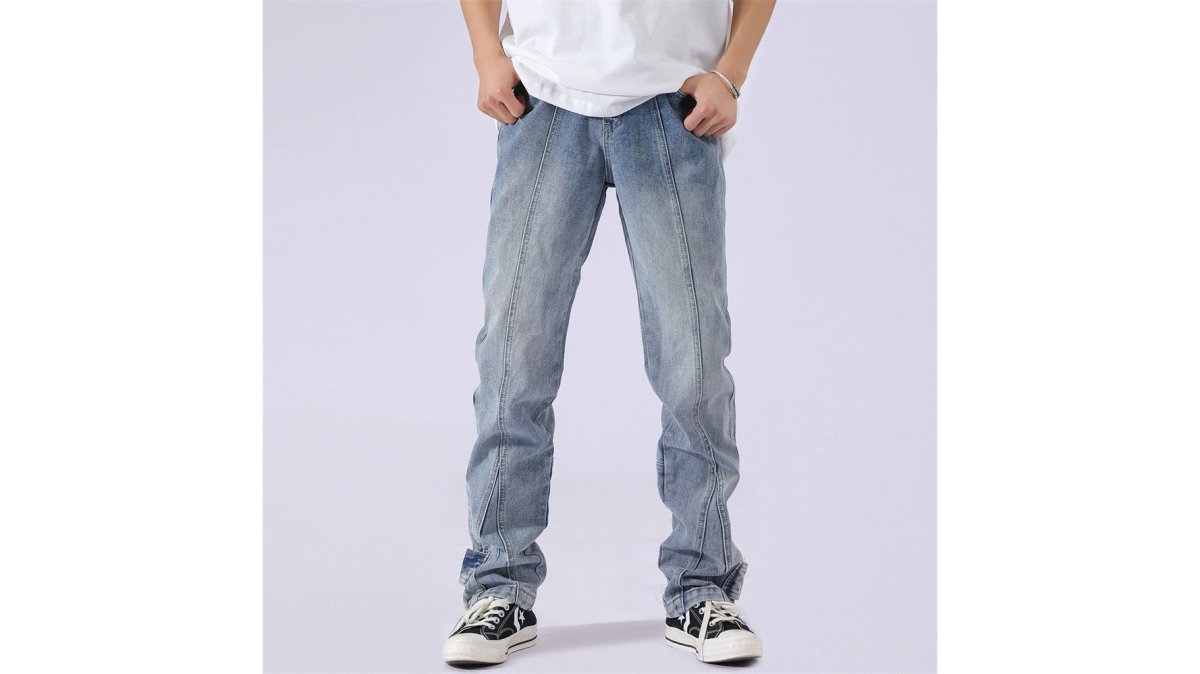
Organic cotton is the most accessible natural fiber for everyday wear. Our Solid Colour Patchwork Straight-leg Jeans For Men at $57.23 delivers 100% cotton in a classic blue with thoughtful patchwork detailing.
For footwear, our Men's Full Grain Leather Slip-On Loafers at $36.37 represent a natural-material investment piece. Full grain leather improves with time, developing a unique patina. The slip-on design means you're not paying for unnecessary features.

Our Men's Vintage Work Boots at $101.48 use recycled leather with a rubber sole, combining durability with responsible sourcing. The patchwork detailing adds character without sacrificing function.
Building a Men's Capsule Wardrobe with Ethical Essentials
A capsule wardrobe is the antidote to fast fashion: instead of chasing trends, you build a small collection of versatile pieces that work across seasons and occasions. This makes ethical shopping affordable because you buy less, more intentionally.
Start with three neutral bottoms: black relaxed-fit jeans, blue straight-leg jeans, and chinos. Add four tops: a Henley, a button-down shirt, a sweater, and a basic tee.
The math works because each piece serves multiple purposes. Your Henley works under a sweater in winter, layered with a shirt in spring, or alone in summer. Your button-down works for the office, weekend dinners, or casual Fridays.
The key is color coordination. Stick to a palette: neutrals (black, white, gray, navy, khaki, brown) plus one or two accent colors. Everything should work with everything else, eliminating the "nothing to wear" problem.
Our Men's Retro Mid-Top Casual Boots at $101.75 in khaki or black fit this strategy perfectly. The mid-top silhouette offers ankle support without the bulk of full-height work boots.
For jeans, our Men's Denim-Look Straight-Leg Pants with Drawstring Waist at $41.45 offers an alternative to traditional denim.
Sizing, Fit, and Returns: What Actually Matters When Shopping Online
Online shopping for men's clothing fails most often at fit. You can't try before you buy, and sizing standards vary wildly across brands.
Our products come with detailed size charts that account for variations in fit across styles, and we track every shipment and stand behind what we send.
One practical tip: order one size up if you're between sizes. Most men's clothing in this category runs slightly fitted, especially in the shoulders and chest.
Return policies matter more for ethical brands because the upfront cost is higher. If you can't return without penalty, you're taking on significant risk.
Building a wardrobe around ethical, stylish men's clothing doesn't require overhauling everything at once. Start with one piece, a quality Henley, a pair of jeans, a pair of boots. Wear it. See how it performs.
Frequently Asked Questions
What's the difference between ethical, sustainable, and non-toxic men's clothing?
Ethical clothing focuses on fair labor practices and transparent supply chains, workers earn living wages and operate in safe conditions. Sustainable clothing prioritizes environmental impact through responsible material sourcing, low-impact production, and durability. Non-toxic clothing avoids harmful chemicals in dyeing and finishing. A truly responsible brand addresses all three: fair wages, environmental care, and safe materials. When shopping for ethical menswear, look for certifications, transparency reports, and specific labor practice disclosures rather than vague marketing claims.
How can you tell if a men's clothing brand is actually ethical?
Check for third-party certifications like Fair Trade Certified, B Corp, or GOTS (Global Organic Textile Standard). Reputable brands publish supply chain information, name their factories, and disclose labor practices. Visit their website and look for detailed sustainability reports or ethics statements. Ask yourself: Do they name specific suppliers? Do they explain their production process? Do they offer pricing transparency? Brands hiding their sourcing or making vague claims about 'conscious' or 'responsible' production without evidence should raise questions.
What materials should you look for in sustainable men's clothing?
Organic cotton, linen, hemp, recycled polyester, and Tencel are strong choices. Organic cotton avoids synthetic pesticides; linen requires minimal processing and is naturally durable. Hemp grows without chemicals and produces strong fabric. Recycled materials reduce waste. Wool from responsibly managed farms offers natural temperature regulation. Avoid fast-fashion synthetics and look for certifications, GOTS for organic fibers, or recycled content labels. Quality basics made from these materials last longer, reducing your need to replace items frequently.
Where can you buy affordable ethical men's basics online?
Hoss Style & Co offers curated ethical basics at accessible prices: cotton sweaters from $30.30, Henley shirts at $27.89, and jeans starting at $35.30. Their full grain leather loafers ($36.37) and vintage work boots ($101.48) provide durable, timeless pieces. Focus on versatile staples, solid-color Henleys, quality denim, neutral sweaters, that mix and match easily. Building a capsule wardrobe with fewer, better pieces costs less over time than buying cheap items repeatedly. Look for brands offering transparent pricing and clear material information.
How do you solve the fit problem when shopping for ethical men's clothing online?
Start by checking detailed size charts and comparing your measurements to the specific garment, not just your usual size. Many ethical brands use Asian sizing, which runs 1-2 sizes smaller than American sizes. Read customer reviews mentioning fit. Choose stores with hassle-free returns, Hoss Style & Co provides reliable shipping and tracked shipping on every order. When ordering, size up if you're between sizes. Pay attention to fit descriptions: slim, relaxed, or oversized. Order multiple sizes if unsure, then return what doesn't work. Over time, you'll learn which brands fit your body.


