

Table of Contents
- What Is a Capsule Wardrobe and Why It Works for Professional Environments
- Capsule Wardrobe Essentials: The Foundation Pieces You Actually Need
- Business Casual Capsule Wardrobe Checklist
- Building a Work Wardrobe on a Budget
- How to Style Professional Outfits That Transition from Office to After-Hours
- Capsule Wardrobe for Travel and Commute
- Common Mistakes to Avoid When Building a Professional Capsule Wardrobe
- Frequently Asked Questions
Last Updated: September 26, 2026
What Is a Capsule Wardrobe and Why It Works for Professional Environments
A capsule wardrobe is a tightly edited collection of clothing pieces that mix and match to create many outfits with minimal items. For professional work environments, a capsule wardrobe removes the daily guesswork of getting dressed while keeping every combination office-appropriate. This guide breaks down which pieces earn their place, how to build the collection on a realistic budget, and where most people go wrong.
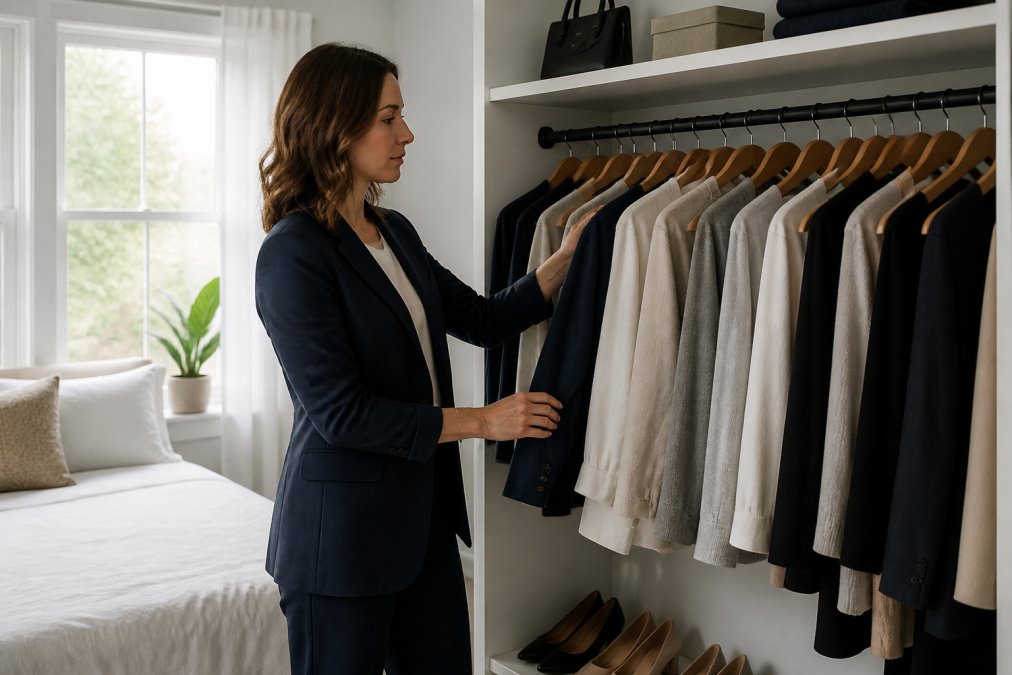
Capsule Wardrobe Essentials: The Foundation Pieces You Actually Need
The foundation of any professional capsule is a small set of versatile separates. Most people land on a core of 25 to 35 pieces covering tops, bottoms, layers, shoes, and one or two structured bags.
Women's Professional Capsule Essentials
For women, the workhorse pieces are a tailored blazer, dress trousers, a pencil skirt or sheath dress, two button-down shirts, a fine-knit sweater, and one pair of closed-toe heels or loafers. A matching blazer and pants set does double duty: worn together it reads formal, split apart each piece extends your options.

Men's Professional Capsule Essentials
Men's capsules run on the same principle: two pairs of dress trousers, three button-down shirts, one blazer, one knit layer, and two pairs of shoes that cover formal and smart casual. Neutral colors, meaning navy, charcoal, gray, black, and white, keep everything interchangeable.
Match the Fabric to the Job, Not Just the Cut
Two garments can look identical on a hanger and behave completely differently by 3 p.m. The fiber content on the care label is the most useful information most shoppers ignore.
- Wool (and wool blends): The default for suiting and dress trousers. It breathes, resists wrinkles, and holds a crease through a full day of meetings; a mostly polyester suit will shine under office lighting and trap heat.
- Cotton: Great for button-down shirts and chinos, but it wrinkles, fine for business casual, less fine for a formal presentation. A cotton-poplin shirt with a touch of stretch is a reasonable compromise.
- Linen: Excellent in summer heat, but it creases almost immediately. In a formal office, linen reads best as a blazer or relaxed shirt, not trousers you sit in all day.
- Silk: Reserved for blouses, scarves, and linings. It drapes beautifully but stains easily and usually needs dry cleaning.
- Synthetic blends (polyester, rayon, spandex): These add stretch, wrinkle resistance, and lower prices. A small percentage of spandex is a practical win; a garment that is almost entirely synthetic tends to pill, shine, and hold odor.
Care and Longevity: The Half of the Capsule Nobody Talks About
A capsule only saves money if the pieces survive. Most professionals replace basics sooner than needed because of avoidable care mistakes.
- Rotate, don't repeat. Wearing the same trousers two days running accelerates wear at the seat and knees. Give each pair a day to rest between wears.
- Read the care label before the first wash. Wool and silk are usually dry-clean or hand-wash only; one hot-water machine cycle can shrink a wool blazer permanently.
- Wash less, spot-clean more. Button-down shirts worn over an undershirt often need only an airing and a press. Over-washing fades and pills a garment fastest.
- Invest in a garment steamer. Steam removes most wrinkles from wool and blends without an iron's heat damage, and it is faster on a busy morning.
- Store structured pieces on shaped hangers. Wire hangers distort blazer shoulders over time; wide wooden or padded hangers preserve the silhouette you paid for.
- Keep a small repair kit. A dropped hem or missing button is a five-minute fix, not a reason to replace a garment. Tailors can re-line a blazer or take in a waist for a fraction of a new piece.
Fit for Different Body Types
"Tailored" does not mean one shape. The same blazer cut that flatters one person can look boxy on another, and the fix is usually a small adjustment, not a different garment.
- Petite frames: Look for cropped or shorter blazer lengths and a higher trouser rise. A hem at the wrong spot visually shortens the leg; a tailor can shorten sleeves and hems cheaply.
- Tall frames: Longer blazers and full-length trousers balance proportion. Avoid cropped jackets that stop above the hip.
- Curvier builds: A single-breasted blazer with a defined waist and slight stretch drapes better than a boxy double-breasted cut. Wrap and sheath dresses with a bit of give are often more flattering than stiff pencil skirts.
- Broader shoulders: Soft-shouldered or unstructured blazers reduce visual width; structured shoulders amplify it.
- Straight or athletic builds: A belted blazer, a defined waist, or a tucked shirt creates shape where the silhouette is otherwise linear.
Business Casual Capsule Wardrobe Checklist
A business casual capsule wardrobe checklist keeps you from overbuying. Use this as a starting framework and adjust for your dress code.
- Two blazers or structured jackets
- Three button-down shirts or blouses
- Two pairs of dress trousers
- One pencil skirt or sheath dress
- One fine-knit sweater or cardigan
- One matching set for formal days
- Two pairs of professional shoes
- One structured bag
- Neutral belt and simple jewelry
The Same Checklist Reads Differently by Industry
"Business casual" is not one dress code but a sliding scale, the same checklist will look overdressed in one office and underdressed in another. Before you buy, calibrate to the field you actually work in.
How to Calibrate Without Guessing
If you are new to a workplace or unsure where it sits, three quick moves tell you more than any style guide:
- Look at the most senior person in the room. Dress codes are set from the top down. If leadership wears blazers daily, that is the real standard, whatever the handbook says.
- Check what people wear on the days that matter. Presentation days, client visits, and all-hands meetings reveal the true ceiling of the dress code.
- Keep one "step up" piece in your capsule. A blazer and dress shoes let you move up a level on short notice without rebuilding your wardrobe.
Building a Work Wardrobe on a Budget
Building a work wardrobe on a budget comes down to cost-per-wear, not sticker price. A $35 pair of trousers worn twice a week for a year costs less per wear than a $15 pair that falls apart in two months.
How to Style Professional Outfits That Transition from Office to After-Hours
Styling professional outfits that move from office to after-hours depends on layering and one or two deliberate swaps. The goal is a base outfit that reads formal at 9 a.m. and relaxed by 7 p.m. without a full change.
Capsule Wardrobe for Travel and Commute
A capsule wardrobe for travel and commute should fit in one carry-on and still cover a full work week. Choose pieces that layer, resist wrinkling, and work for both the office and the flight.
Common Mistakes to Avoid When Building a Professional Capsule Wardrobe
The most common mistake is buying for a fantasy version of your job rather than the one you actually have. If you sit at a desk four days a week, you need comfortable trousers, not three more blazers.
Other frequent missteps:
- Ignoring your workplace dress code and overdressing or underdressing consistently
- Buying only statement pieces that do not pair with anything else
- Skipping tailoring, which is what makes an inexpensive garment look expensive
- Choosing colors you like in a store rather than colors that match your existing pieces
- Replacing basics too slowly, so the capsule never actually functions as a system
Frequently Asked Questions
What is the 3-3-3 rule for a capsule wardrobe?
The 3-3-3 rule is a simple framework for building a capsule wardrobe. It suggests choosing three bottoms, three tops, and three pairs of shoes that all mix and match. This creates nine distinct outfit combinations from just nine items. For professional environments, you might pick three dress trousers, three button-down shirts, and three pairs of shoes that work for the office. The rule helps you build a versatile foundation without overbuying, making it easier to get dressed quickly each morning.
How many items should be in a professional capsule wardrobe?
A professional capsule wardrobe typically includes 25 to 35 items, including shoes and outerwear but excluding accessories. The exact number depends on your workplace dress code and how often you do laundry. A business casual capsule wardrobe checklist might include 5 bottoms, 7 tops, 3 blazers, 3 pairs of shoes, and 2 dresses or suits. The goal is to have enough variety for two weeks of work outfits without duplicates. Focus on quality and versatility rather than hitting a specific number.
What are the essential colors for a business casual wardrobe?
Stick to neutral colors as your base: navy, charcoal, black, gray, and tan. These shades mix easily and look professional in any office. Add one or two accent colors like burgundy, olive, or soft blue to keep outfits interesting. For a business casual capsule wardrobe checklist, aim for 80% neutrals and 20% accents. This ratio ensures almost everything matches, which makes building outfits faster and reduces the need for extra pieces. You can always add seasonal colors later.
How can I build a professional wardrobe on a budget?
Start by shopping your closet and identifying gaps. Then prioritize investment pieces like a well-fitting blazer or quality dress shoes that you will wear multiple times per week. For building a work wardrobe on a budget, look for sales on classic items and choose versatile fabrics that hold up to repeated wear. Hoss Style & Co offers professional pieces like the Men's Full Grain Leather Slip-On Loafers for $36.37 and the Women's Blazer and Wide Leg Pants Set for $127.57, which can anchor multiple outfits without a luxury price tag.
Professional wardrobes fail for a boring reason: most people buy pieces in isolation instead of building a system. Hoss Style & Co LLC curates versatile separates for both men and women, with secure checkout and reliable tracked shipping, so you can build a foundation without the guesswork. Start with the matching set or the leather shoes that anchor your week, then add pieces as you confirm what fits. Shop All and build the wardrobe that gets you dressed in five minutes flat.


