

Table of Contents
- What Luxury Markups Actually Pay For
- How to Spot Quality Clothing Before You Buy
- Materials and Construction That Justify the Price
- Why Best Direct-to-Consumer Clothing Brands Cost Less
- Capsule Wardrobe Essentials That Earn Their Keep
- Care and Maintenance: Making High Quality Clothing Last
- Red Flags in Affordable Luxury Marketing
- Frequently Asked Questions
Last Updated: September 24, 2026
What Luxury Markups Actually Pay For
A designer price tag rarely reflects the cost of making the garment. It reflects marketing, prime retail space, and name protection. That gap is why high quality clothing without luxury markups is now realistic for everyday shoppers, not a compromise.
- Retail rent and staffing at flagship locations in high-traffic areas
- Brand marketing including campaigns, influencers, and celebrity placements
- Wholesale margin stacking where the maker, the distributor, and the store each take a cut
- Seasonal markdowns built into the original price to absorb end-of-season discounts
How to Spot Quality Clothing Before You Buy
Learning how to spot quality clothing takes about thirty seconds per garment once you know what to look for. Check the seams, fabric weight, and hardware, in that order, starting with the inside, since a well-made piece looks as tidy inside as on the hanger.
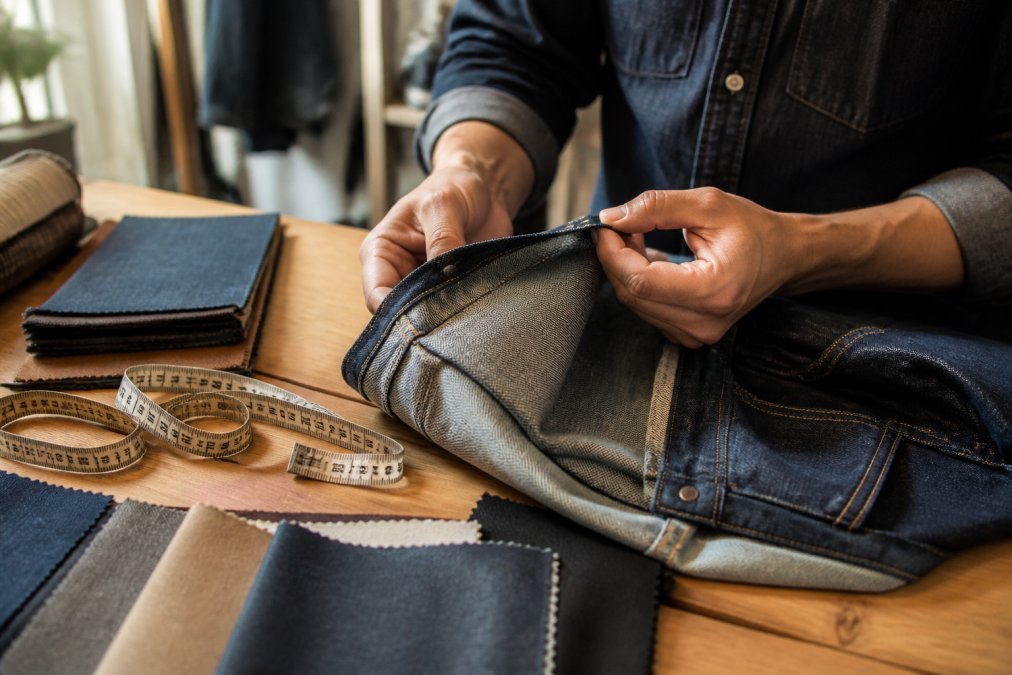
- Seam allowance: Is it wide enough to prevent fraying, and are the raw edges finished?
- Stitch density: Tight, even stitching with no loose threads or skipped sections
- Fabric weight: Hold it up to light. Can you see through it when you should not?
- Hardware: Do zippers glide smoothly? Are buttons securely anchored with cross-stitching?
- Pattern matching: On prints and stripes, do the lines align at the seams?
- Reinforcement: Are stress points like pocket corners and belt loops double-stitched?
Materials and Construction That Justify the Price
The materials that justify a higher price hold their shape, resist pilling, and keep their color after repeated washing. Everything else is marketing. To judge that, you need two numbers most product pages bury: fabric weight and fiber composition.
Fabric weight, measured in GSM
GSM stands for grams per square meter, the single most useful spec for comparing two garments that look identical online. A lightweight cotton tee lands around 140-160 GSM, midweight around 180-200 GSM, and heavy at 220 GSM and up. Denim works the same way: mass-market denim sits near 10-12 oz per square yard, while a substantial pair runs 12-14 oz and heavier.
Weave and knit structure
Fiber alone does not determine how a fabric behaves. Structure does.
- Plain weave, a simple over-under interlacing. Tight, durable, and used in poplin and most shirting.
- Twill weave, diagonal ridges that hide soil and resist tearing. Denim and chino are twills.
- Satin weave, floats that create sheen and drape but snag more easily.
- Jersey knit, a single knit with stretch and a soft hand, common in tees.
- Rib knit, vertical ridges with high recovery, used at cuffs and necklines.
Fiber sourcing and what it signals
Fiber length matters more than most shoppers realize. Longer staple fibers, extra-long staple (ELS) cotton, for example, spin into stronger, smoother yarn that pills less because fewer fiber ends reach the surface. Short-staple cotton is cheaper and shows its age faster. The same applies to wool: finer micron counts feel softer, while coarser wool is more durable but scratchier.
Construction markers worth checking
| Construction Detail | What It Signals | Why It Matters |
|---|---|---|
| Double-stitched seams | Reinforced stress points | Survives repeated wear and washing |
| Bound or finished edges | Care in manufacturing | Prevents fraying and unraveling |
| Bar tacks at pockets | Structural reinforcement | Pocket corners won't tear |
| Even topstitching | Quality assurance | Straight lines indicate consistent workmanship |
| Substantial fabric weight | Textile durability | Holds shape, resists transparency |
| Lockstitch vs. chainstitch | Different failure modes | Chainstitch has give; lockstitch is stronger but less elastic |
How to read a care and content label like a buyer
A label listing fiber content, weight, and country of origin tells you more than any hangtag adjective. If a product page omits GSM, weave, or fiber percentages, treat the omission as information. Brands confident in their materials publish specs; brands relying on feel alone usually do not.
Why Best Direct-to-Consumer Clothing Brands Cost Less
The best direct-to-consumer clothing brands cost less because they sell straight to you, cutting the wholesale and retail layers that inflate traditional pricing. No middlemen means no margin stacking. In the standard supply chain, a factory sells to a brand, the brand sells to a distributor or retailer at wholesale, and the retailer marks it up again. Each step adds cost without adding anything to the garment.
Capsule Wardrobe Essentials That Earn Their Keep
Capsule wardrobe essentials are the pieces you reach for weekly, not the ones that look good in a single outfit. A tight rotation of versatile staples outperforms a closet full of one-off purchases. The math is simple: a garment you wear fifty times a year costs far less per wear than one you wear three times. Cost-per-wear is the only metric that matters when deciding whether a purchase is worth it.
Build around these categories:
- Bottoms: Two to three pairs of denim in different fits and washes
- Tops: Neutral and solid pieces that layer easily
- Outerwear: One structured layer, one relaxed layer
- Shoes: One everyday pair, one that works for occasions
Care and Maintenance: Making High Quality Clothing Last
Care and maintenance determine whether a good garment lasts three years or ten. Washing less often, in colder water, and drying on low heat extends the life of almost any fabric. But the real argument for caring for your clothes is arithmetic, not sentiment.
Loose Fit White Denim Women's High →
Cost-per-wear: the only number that matters
Cost-per-wear is total purchase price divided by the number of times you actually wear the item. A $30 pair of jeans worn 150 times costs $0.20 per wear; a $15 pair worn 20 times before it fades costs $0.75 per wear. The cheaper garment is nearly four times more expensive per use.
The habits that actually extend garment life
The care label is a floor, not a ceiling. Most garments can handle gentler treatment than the label's maximum. A few habits make the biggest difference:
- Wash inside out to protect the outer surface from friction
- Use cold water to reduce color fading and fiber stress
- Skip the dryer when you can; air drying preserves elasticity
- Turn down the heat on your iron, and press inside out
- Store folded, not hung, for knits that stretch on hangers
- Use mesh bags for delicates and anything with hardware that could snag neighbors
- Zip zippers and button buttons before washing to prevent snags and keep shape
Denim-specific care
Denim deserves special attention. Washing too frequently breaks down the indigo and fiber structure, so spot-cleaning and airing between wears keeps denim fresh far longer than a weekly wash. When you do wash, turn it inside out, use cold water on a gentle cycle, and hang to dry. Avoid fabric softener, which coats fibers and reduces the recovery that gives stretch denim its shape.
When repair beats replacement
A loose button, a small seam separation, or a worn hem is a repair, not a retirement. Learning a basic backstitch and keeping a needle and matching thread on hand turns a $5 tailor visit into a five-minute fix. Replacing a zipper pull or reinforcing a pocket corner costs far less than replacing the garment, and keeps the cost-per-wear number falling instead of resetting.
Red Flags in Affordable Luxury Marketing
Red flags in affordable luxury marketing usually show up in the language, not the product. Vague "premium quality" claims without specifications are the clearest warning sign.
Watch for these patterns:
- No fiber content listed. If the composition is hidden, there is usually a reason.
- "Luxury" used as a standalone adjective with no supporting detail about materials or construction
- Original prices crossed out to create a permanent "sale" that never actually ends
- Stock photography instead of real product images, which makes it impossible to judge construction
- No size chart or measurement guide, which signals a brand that has not done the work
- Pressure tactics like countdown timers on items that are never actually out of stock
Frequently Asked Questions
Where can I get good quality clothes that aren't expensive?
Look for direct-to-consumer brands that sell factory-direct and skip retail markup. Check fabric weight and stitching quality before buying. For example, a pair of high-waisted straight-leg denim jeans for women costs $64.96 at Hoss Style & Co, while similar designer pairs often sell for $150 or more. Focus on cost-per-wear: a $35 pair worn 100 times costs $0.35 per wear.
How do I identify quality fabrics when shopping online?
Read the material composition carefully. Natural fibers like cotton, linen, and wool generally breathe better and last longer than synthetic blends. Check fabric weight when listed (heavier denim, for instance, holds shape longer). Look for details like reinforced stitching and clean seam finishes in product photos. Brands that publish detailed specs and care instructions are usually more transparent about quality.
How do direct-to-consumer brands keep prices lower than traditional retailers?
Direct-to-consumer brands sell straight from the factory or manufacturer to you, cutting out wholesalers and retail stores. That removes the traditional retail markup, which can be 2.5 to 3 times the wholesale cost. The savings come from fewer middlemen, not lower quality. Many DTC brands also use pre-orders or smaller production runs to avoid excess inventory and markdowns.
What should I look for in a capsule wardrobe on a budget?
Start with versatile pieces you can wear multiple ways: well-fitting denim, plain tees, a button-down, and a jacket. Choose neutral colors that mix easily. Prioritize fabric durability and stitching quality over trends. A capsule of 10 to 15 items can create 30 or more outfits. Hoss Style & Co offers denim staples like the Loose Fit White Denim High Waist Pants at $34.17 that fit this approach.


