

Table of Contents
- Stylish and Comfortable Clothing vs Confidence-Boosting Fashion: What's the Real Difference?
- Comparison Table: How Each Approach Measures Up
- The Psychology Behind Stylish and Comfortable Clothing
- Comfortable Professional Attire for Women 2026: Work-to-Weekend Pieces That Perform
- How to Curate a Capsule Wardrobe for Work Without Sacrificing Style
- Fit, Tailoring, and Fabric: The Details That Decide Everything
- Where Each Approach Wins: Use Cases and What to Buy
- Conclusion
- Frequently Asked Questions
Last Updated: September 10, 2026
Stylish and Comfortable Clothing vs Confidence-Boosting Fashion: What's the Real Difference?
Stylish and comfortable clothing and confidence-boosting fashion are not opposites, and treating them as a trade-off is the single biggest mistake shoppers make. People often assume a polished look requires pinching waistbands and stiff fabrics, while anything genuinely soft must read as sloppy. That assumption can cost you money and comfort.
The real difference comes down to intent. One approach prioritizes how a garment feels against your body across a full day. The other prioritizes how it makes you carry yourself. The overlap between them is where a genuinely useful wardrobe lives.
This comparison breaks down where each approach wins, where it fails, and how to build a collection that does both. Below, we'll show you exactly which pieces earn their place and which ones just take up hanger space.
Comparison Table: How Each Approach Measures Up
The two approaches diverge on fabric, fit philosophy, and how you shop for them. Here is the honest breakdown.
| Factor | Stylish & Comfortable | Confidence-Boosting |
|---|---|---|
| Priority | All-day wearability | Presence and self-perception |
| Fabric focus | Stretch, fleece, cotton blends | Tailoring, texture, structure |
| Fit philosophy | Relaxed, forgiving | Sharp, defined silhouette |
| Best for | Long workdays, travel, errands | Presentations, interviews, events |
| Typical risk | Looks too casual for formal settings | Sits unworn because it feels stiff |
| Shopping approach | Buy multiples of what works | Buy fewer, more deliberate pieces |
| Values signal | Often overlooked in fast-fashion buys | Strengthened when pieces align with your ethics |
| Body relationship | Accommodates the body as-is | Can reinforce "flattering" pressure if unchecked |
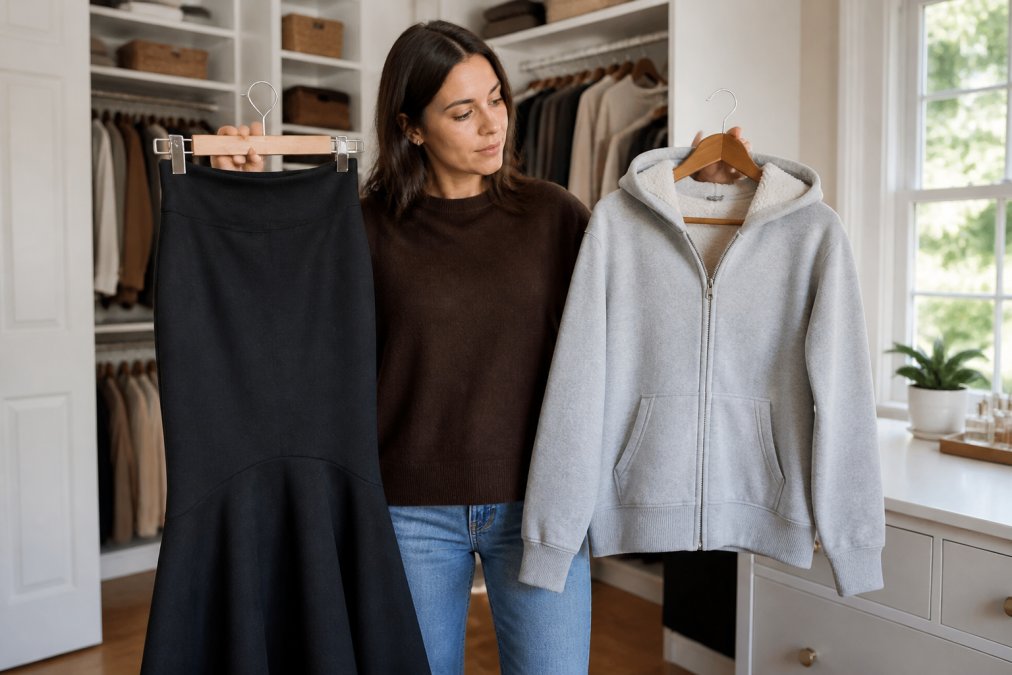
The tension between these two columns is real, but it is not permanent. A stretch pencil skirt sits in both camps at once: structured enough to read as professional, elastic enough to wear for ten hours. That is the sweet spot to shop for.
Two rows in that table deserve more attention than they usually get. The values signal row matters because a garment that conflicts with your ethics, a synthetic blend you know will pill in a month, a piece made under conditions you would not endorse, creates a low-grade discomfort that no amount of tailoring fixes. Confidence is often easier to sustain when the clothes on your back match the values you hold. The body relationship row matters for the same reason: confidence-boosting fashion can quietly slide into "flattering" pressure, where the goal becomes hiding rather than expressing. Body neutrality offers a corrective. Instead of asking whether a piece makes you look thinner or curvier, ask whether it lets you move, breathe, and forget you are wearing it. That reframe keeps the confidence column from turning into a source of anxiety.
The Psychology Behind Stylish and Comfortable Clothing
What you wear changes how you think, not just how you look. Researchers call this enclothed cognition, the idea that clothing carries symbolic meaning that shifts your mental state and behavior (PubMed). A garment you associate with competence tends to make you feel more competent.
That is why the comfort-versus-confidence debate misses the point. The psychological benefits of dressing well do not require discomfort. In practice, the confidence boost comes from fit and intention, not from restriction. A well-tailored jacket that lets you move freely does more for your self-esteem than a rigid one you keep tugging at.
Comfortable Professional Attire for Women 2026: Work-to-Weekend Pieces That Perform
The best comfortable professional attire for women in 2026 is built on stretch fabrics, forgiving silhouettes, and pieces that move from a morning meeting to a weekend dinner without a costume change. The category has matured well beyond basic knit blazers.
Here is what actually earns a spot in a work-to-weekend rotation:
- A high-waist stretch fishtail skirt, which reads formal but flexes with you. Ours runs $23.89 and pairs with a blouse or a simple tee.
- A fleece-lined zip hoodie, for the cold-office-to-casual-commute problem. Ours is $24.99.
- A turtleneck drawstring sweatshirt, which layers under a structured coat without bulk. Ours is $24.50.
- A cotton hooded sweatshirt, the honest weekend staple that still looks intentional. Ours is $24.34.
The thing nobody tells you about work-to-weekend dressing is that it depends far more on silhouette than on category. A sweatshirt in a clean, fitted cut reads sharper than a rumpled button-down.

How to Curate a Capsule Wardrobe for Work Without Sacrificing Style
Learning how to curate a capsule wardrobe for work starts with a simple rule: every piece must pair with at least three others you already own. A capsule is not about owning less for its own sake. It is about removing the daily friction of deciding what to wear.
The mechanics work like this. Pick two base colors and one accent. Choose three bottoms, five tops, two layers, and two pairs of shoes. Then test each new piece against that grid before buying. If it only works with one outfit, it is not a capsule piece, it is a one-off.
A common mistake is buying a capsule all at once. Most people who try that end up with pieces that fit a hypothetical life, not their actual one. Build it over a season instead, replacing what wears out with something that fits the grid.
Fit, Tailoring, and Fabric: The Details That Decide Everything
Fit and silhouette decide whether a garment looks expensive or cheap, regardless of what you paid. A $24 top that fits your shoulders correctly will outclass a poorly sized designer piece every time (peer-reviewed research).
Three details matter most. First, shoulder and waist placement: these anchor the whole silhouette. Second, fabric recovery, meaning whether a stretch fabric snaps back after a day of wear or sags permanently. Third, texture: a mix of smooth and textured fabrics reads more deliberate than a single flat material head to toe.
Tailoring does not require a tailor for every piece. A simple hem adjustment on a skirt or a sleeve length fix is often the only change needed to move a garment from "fine" to "flattering." Many brands now offer these basics in cuts that need less alteration.
Where Each Approach Wins: Use Cases and What to Buy
Each approach has a clear home, and matching them to the right context is the whole game. Confidence-boosting fashion wins in high-stakes, high-visibility moments. Comfort-first fashion wins in the long, unglamorous stretches where you need to keep moving.
- Choose confidence-boosting pieces for: interviews, client presentations, first dates, events where you will be photographed.
- Choose comfort-first pieces for: travel days, remote work, long commutes, errands, recovery days.
- Choose the overlap for: standard office days, casual Fridays, weekend brunch, anything that runs long.
That list is where most advice stops. The more useful question is what to do when the two columns pull in opposite directions, and that is where the angles most competitors skip become the deciding factor.
The sustainability filter. Before you buy a confidence-boosting piece, ask how many wears it will survive. A structured blazer that holds its shape for five years earns its cost per wear; a trend-driven top that pills after three washes does not, no matter how good it looked in the dressing room (the EPA). A common pattern is to spend more on the pieces that carry your silhouette, a skirt, a jacket, a pair of shoes, and less on the layers that rotate. That approach can do more for both your confidence and your conscience than chasing seasonal drops, and it is the same logic that can make a curated collection a valuable choice.
The body-neutrality filter. Confidence-boosting fashion traditionally assumes you are dressing toward a target silhouette. Body neutrality flips that: dress the body you have now, in clothes that let you forget you are wearing them. In practice, that means prioritizing movement over compression. Can you raise your arms without the waistband riding up? Can you sit for an hour without adjusting? If the answer is no, the piece is working against the confidence it was supposed to create. This is not a rejection of tailoring, it is a test for whether the tailoring serves you or the other way around.
The capsule test. Run every candidate piece through a simple grid: two base colors, one accent, three bottoms, five tops, two layers, two pairs of shoes. If a new piece only pairs with one outfit you already own, it is a one-off, not a capsule piece. If it pairs with three or more, it earns a hanger. This test is the fastest way to stop buying clothes that look good in isolation but never make it into rotation.
A sustainable angle matters here too. Buying fewer, better-fitting pieces and wearing them for years does more for both your confidence and your conscience than chasing fast-fashion trends. The same logic applies to body neutrality: dress the body you have now, not a projected version of it. A curated collection should fit your actual life.
Conclusion
The real challenge is not choosing between comfort and confidence. It is finding pieces that deliver both without forcing you to compromise on either. At Hoss Style & Co LLC, that overlap is the entire point of our curated collection: versatile pieces designed to make looking good effortless, backed by secure checkout and reliable, tracked shipping on every order. Browse the fishtail skirts, fleece-lined hoodies, and everyday staples that do the work for you. Get started with Hoss Style & Co LLC and build a wardrobe that feels as good as it looks.
Frequently Asked Questions
Does wearing stylish and comfortable clothing actually make you more confident?
Research on enclothed cognition suggests that what you wear affects how you think and perform. When clothing fits well and feels comfortable, you move more freely and spend less energy adjusting or tugging at your outfit. That physical ease translates into better body language, which feeds into how confident you appear and feel. The key is choosing pieces that satisfy both needs at once rather than treating comfort and style as opposing goals.
What is the 3-3-3 rule in fashion?
The 3-3-3 rule is a wardrobe planning guideline: three colors, three textures, and three silhouettes that mix and match across your closet. The idea is that limiting your palette and shapes makes every combination work together, so getting dressed takes less time and produces more consistent results. For anyone building a capsule wardrobe for work, this framework keeps you from buying one-off pieces that only match a single outfit.
How do I balance comfortable professional attire for women in 2026 with a confidence-boosting look?
Start with stretch fabrics that hold their shape, like a high-waist stretch skirt or a structured but soft sweatshirt. Build around neutral base colors and add one statement piece per outfit. Prioritize fit over brand labels: a $24 garment that fits your silhouette beats a $200 piece that pulls at the shoulders. When your clothes move with you and flatter your shape, comfort and confidence stop competing.
Can comfortable clothing be considered high-fashion or confidence-boosting?
Yes. The old assumption that style requires discomfort has faded. Stretch pencil skirts, fleece-lined hoodies, and relaxed turtleneck sweatshirts now appear in curated collections because they deliver both. The deciding factor is not stiffness but intention: clean lines, deliberate color choices, and a fit that respects your body. A well-tailored stretch piece can read just as polished as a rigid structured garment, and you will actually wear it more often.
How do curated fashion collections simplify the choice between comfort and style?
A curated collection removes the guesswork by pre-selecting pieces that already balance both priorities. Instead of scrolling through thousands of options and guessing whether something will fit or feel right, you choose from a smaller set where each item is designed to work with the others. That saves time, reduces returns, and makes building a cohesive wardrobe faster. The result is fewer decisions and more outfits that actually get worn.


