

Table of Contents
- Why Affordable Modern Fashion Works for Busy Adults
- Capsule Wardrobe Essentials for Busy Adults
- How to Build a Capsule Wardrobe on a Budget
- Cardigan Clothing and Layering Pieces That Do Double Duty
- Affordable Modern Fashion Picks for Work-to-Casual Days
- Maintenance and Care: Making Affordable Pieces Last
- Frequently Asked Questions
Last Updated: September 13, 2026
Why Affordable Modern Fashion Works for Busy Adults
Affordable modern fashion means building a small, versatile wardrobe from well-made, reasonably priced pieces that move between work and personal life. At Hoss Style & Co LLC, shoppers want fewer, better items instead of a closet full of things they never wear.
The math backs that up. The average American household spends a meaningful share of its income on apparel each year, yet most people report wearing only a fraction of what they own, according to Bureau of Labor Statistics consumer expenditure data. When you buy less and choose more carefully, each piece earns its place.
Below, we'll show you how to build that wardrobe without losing your weekends to shopping: a capsule foundation, a budget plan, layering pieces that work double duty, and care habits that stretch every dollar.
Capsule Wardrobe Essentials for Busy Adults
Capsule wardrobe essentials for busy adults are the core items that mix and match across seasons: neutral bottoms, a few structured tops, one or two jackets, and shoes that handle both office and weekend. A working capsule usually runs 25 to 40 pieces, including shoes and outerwear (thegoodtrade.com). The point is coordination, not restriction: every piece should pair with at least three others you already own.
The 3-3-3 Rule for Building a Capsule
Our simplest framework, and it works from almost any starting point:
- 3 base colors. Pick three neutrals (for example, black, navy, and gray) and buy most of your bottoms and outerwear within them.
- 3 top styles. Choose three silhouettes you actually wear, such as a collared shirt, a knit top, and a simple tee.
- 3 shoe types. One pair for work, one smart-casual pair, and one casual pair covers nearly every week.
Follow the rule for one season, then repeat it as the weather turns. The colors stay constant, so spring pieces still work in fall.
How to Build a Capsule Wardrobe on a Budget
Building a capsule wardrobe on a budget comes down to sequence: audit what you own, choose a color palette, then buy only the gaps. Most people do it backwards, buying before they know what's missing.
Step-by-Step: Audit, Choose, Coordinate
- Audit (about 45 minutes). Pull everything out. Make three piles: wears often, wears rarely, and never wears. The "never" pile is your evidence, not your guilt.
- Choose your palette (15 minutes). Pick three base colors and two accent colors, and keep the note on your phone while shopping.
- List the gaps (20 minutes). Identify what the "wears often" pile is missing. A capsule usually needs one or two work bottoms, one layer, and one pair of shoes.
- Set a per-piece ceiling. Decide your maximum price per item before you shop, so one purchase can't wreck the month.
- Coordinate before you buy. Check that each new piece pairs with at least three items you already own.
| Step | Time Needed | What You Need | Output |
|---|---|---|---|
| Audit | 45 minutes | Full closet access | Three sorted piles |
| Choose palette | 15 minutes | Pen and paper | 3 base + 2 accent colors |
| List gaps | 20 minutes | Your "often" pile | 3-5 specific items |
| Set budget ceiling | 5 minutes | Monthly clothing budget | Max price per item |
| Coordinate check | 10 minutes per item | Your existing wardrobe | Confirmed outfit matches |
Cardigan Clothing and Layering Pieces That Do Double Duty
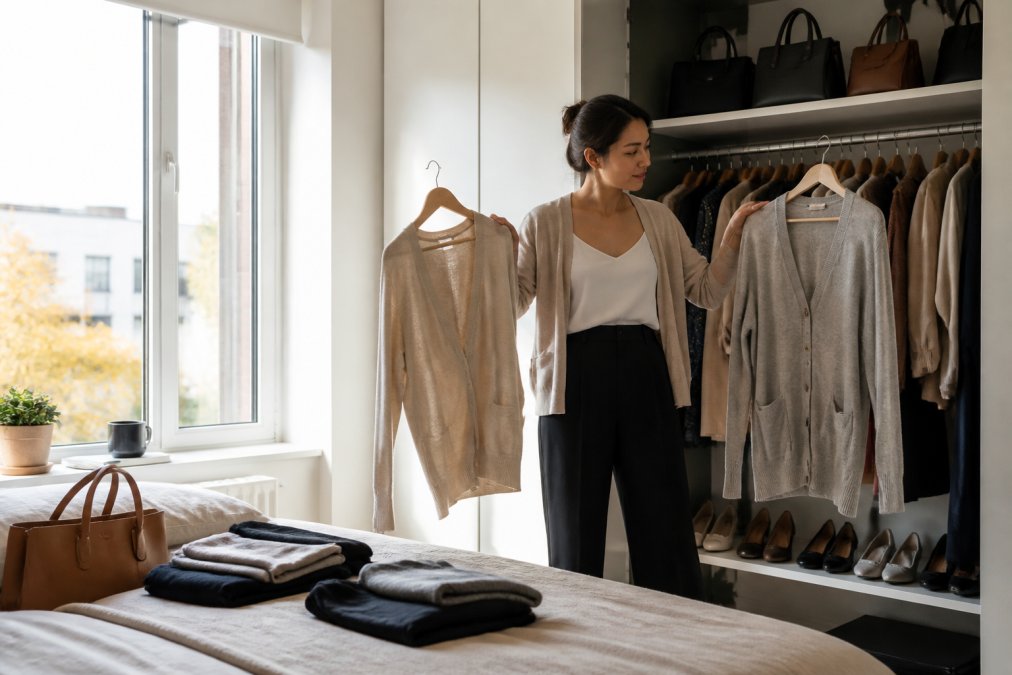
Cardigan clothing earns its place in a capsule because one piece covers three situations: over a collared shirt for meetings, over a tee for weekends, and under a jacket when temperatures drop. A neutral cardigan in your base palette outworks three trend pieces combined.
Layering is where budget wardrobes hold together or fall apart. Thin layers add warmth without bulk, letting the same base outfit go from a cool commute into a warm office. Treat layers as a system with fixed weights, not random sweaters pulled off a shelf.
The three-weight layering system
Three fabric weights cover a full year of indoor and outdoor transitions:
- Lightweight (about 5-7 oz cotton or a fine-gauge knit). Worn alone in spring and fall, or under a jacket in winter. Your everyday cardigan or long-sleeve tee.
- Midweight (about 8-10 oz cotton or a merino-blend knit). The workhorse layer: warm enough for a 60°F office, thin enough to sit under a blazer without pulling at the shoulders.
- Heavyweight (wool blend, fleece, or a lined overshirt). For outdoor cold and the commute, then removed at the desk.
Buy one piece in each weight in your base colors, and you have nine layer combinations from three garments.
Layering rules that save money over time
- Buy layers in your base colors so they work over every top you own.
- Choose fabrics that hold their shape after washing; stretched-out knits get retired early, and ribbed cuffs and hem bands are the first place cheap knits fail.
- Keep one heavier layer for cold months and one light layer for the rest of the year.
- Match layer length to the base piece: a hip-length cardigan over a tucked shirt, a longer layer over a tunic or dress.
- Test the "three-outfit rule" before buying. If a layer can't complete three outfits you already own, leave it on the rack.
Time-saving outfit formulas
Busy adults don't need more clothes; they need fewer decisions. These four formulas take under two minutes each and use only pieces already in a 25-40 item capsule:
- Meeting formula. Collared shirt + midweight cardigan + structured trousers + leather shoes.
- Commute formula. Tee + lightweight cardigan + chinos + smart-casual sneakers, with a heavier layer carried in a tote.
- Weekend formula. Knit top + jeans or casual trousers + casual shoes, with the cardigan tied at the waist if the day warms up.
- Travel formula. Wrinkle-resistant jacket + lightweight layer + one pair of trousers that works for both dinner and the flight home.
Affordable Modern Fashion Picks for Work-to-Casual Days
Affordable modern fashion works best when a single piece handles both a meeting and a dinner. These current picks from the Hoss Style & Co LLC collection do that job, with prices as listed.
- Women's Blazer and Wide Leg Pants Set ($127.57). A tailored blazer and matching trousers in lightweight polyester. Wear the set for the office, then split it: blazer over jeans, trousers with a fitted blouse. One purchase covers a full week of outfits.
- New Stylish Thermal Business Executive Jacket For Men ($72.68). Slim fit, wrinkle-free treatment, zippered welt pockets, four colorways including black and gray. The wrinkle-free finish matters on work trips, when there's no time for an iron.
- Solid-color, Lightweight Business Casual Chinos ($37.84). Cotton, slightly stretchy, mid-rise, available up to XXXL. The lowest price here and the easiest way to add a second work bottom without stretching the budget.
- Four Seasons Slim Fit Men's Casual Trousers ($43.65). High elasticity and a high waist, cut for plus-size wearers, eight colors. The stretch is the selling point for long commutes.
- Men's Leather Business Dress Shoes ($201.68). Cowhide upper, rubber outsole, round toe. The investment piece here, worth paying more for because a resolable leather shoe outlasts three cheap pairs.
Jackets, Trousers, and Shoes That Transition

The transition rule is simple: if a piece can't appear in two settings, it's a costume, not a staple. The blazer set, executive jacket, and chinos all clear that bar, the chinos read as business casual with a collared shirt and as weekend wear with a tee.
Maintenance and Care: Making Affordable Pieces Last
Care separates a wardrobe that lasts three years from one that lasts ten. Cost-per-wear is the number that matters: a $40 pair of trousers worn 80 times costs 50 cents per wear, beating a $15 pair worn five times at $3 per wear. Affordable pieces need a specific routine to survive the fiftieth wear.
The cost-per-wear formula
Divide the purchase price by the number of times you realistically expect to wear the item. A $200 pair of resolable leather dress shoes worn twice a week for three years lands near $0.64 per wear, while a $30 glued-sole pair replaced every eight months costs more per wear despite the lower sticker price. Run the math before you buy.

Wash frequency by garment type
Over-washing is the fastest way to destroy affordable clothing. People who keep clothes for years follow this pattern:
- Tees and undershirts. Wash after every wear.
- Button-down shirts. One to two wears if worn over an undershirt; wash sooner if worn against the skin in summer.
- Knit sweaters and cardigans. Every three to five wears. Air them between wears instead of laundering.
- Trousers and chinos. Every three to four wears. Spot-clean small marks rather than running a full cycle.
- Jackets, blazers, and outerwear. Once or twice a season, or when visibly soiled. Dry-clean sparingly; it wears down fibers.
- Denim. Every five to ten wears, inside out, cold water, hang dry.
Care habits that extend clothing life
- Turn knits inside out and use cold water to reduce pilling and fading.
- Hang structured jackets and blazers on shaped hangers instead of folding them.
- Rotate shoes with a day of rest between wears, which lets moisture dry and holds the shape. Cedar shoe trees speed this up.
- Use mesh laundry bags for knits and anything with buttons or hardware.
- Store folded knits flat rather than on hangers, which stretches shoulders over time.
- Repair early. A loose button or small seam takes minutes to fix and prevents a larger failure later. A basic sewing kit and a $5 tailor visit handle most repairs.
Reading care labels correctly
The FTC's guidance on clothing care labels explains what the symbols on your garments actually require, which is worth checking before you improvise a wash cycle on a structured piece. When a label says "dry clean only" on a budget item, a gentle hand-wash in cold water with a mild detergent is often safe for cotton and polyester blends, but test on a hidden seam first.
A simple seasonal maintenance routine
Twice a year, at the start and end of each season, spend about 30 minutes on the wardrobe:
- Wash or dry-clean everything before storing it. Stains set over months.
- Repair buttons, seams, and hems while the item is out of rotation.
- Store off-season pieces clean, folded, and in breathable cotton bags rather than vacuum-sealed plastic.
- Note what wore out and why. Repeated failure at elbows, knees, or cuffs tells you which fabrics to avoid next time.
Frequently Asked Questions
What is the 3-3-3 rule for clothes?
The 3-3-3 rule is a simple capsule wardrobe formula: three tops, three bottoms, and three pairs of shoes that all coordinate with each other. That gives you 27 possible outfit combinations from just nine items. For busy adults, it removes morning decision fatigue because every piece works together. Start with neutral colors like black, navy, and gray so mixing feels effortless. Add one accent color or pattern if you want variety without breaking the system.
How can busy adults build a capsule wardrobe on a budget?
Start with a wardrobe audit: pull out everything you wore in the last month and set the rest aside. Identify gaps, then buy only pieces that match at least three existing items. Focus on cost-per-wear rather than sticker price. A $43.65 pair of trousers worn twice a week costs less per wear than a $15 pair worn once. Prioritize versatile fabrics and timeless silhouettes over seasonal trends, and shop sales for elevated basics you will wear year-round.
What are the essential modern fashion pieces for a busy lifestyle?
The core pieces are a structured jacket, two pairs of well-fitting trousers, a cardigan or layering piece, one versatile pair of shoes, and a bag that transitions from work to weekend. For men, a thermal business jacket and slim-fit trousers cover most days. For women, a blazer and wide-leg pants set handles office and after-hours events. Add a crossbody bag or messenger bag to keep essentials organized. These pieces mix into dozens of outfits without extra shopping.
How do you maintain a high-quality look with inexpensive clothing?
Care matters more than price. Wash dark colors inside out in cold water, air-dry when possible, and use a fabric shaver on knits to remove pilling. Store cardigans folded rather than hung to keep their shape. Iron or steam collars and hems before wearing. Rotate your shoes and use shoe trees to extend their life. These habits keep affordable modern fashion looking sharp for years, which lowers your cost-per-wear and reduces how often you replace pieces.
How to shop for versatile clothing that saves time in the morning?
Buy pieces that work in at least three settings: office, casual outing, and travel. Stick to a tight color palette so everything coordinates without thought. Choose fabrics with slight stretch for comfort during long days. Keep a go-to formula like jacket, trousers, and a neutral shoe that you can repeat in different colors. When your wardrobe is built on coordination, getting dressed takes minutes instead of staring at a full closet with nothing to wear.


